Project Abstract
The VIRTUS project addresses the critical raw materials (CRM) crisis in Europe by developing a comprehensive, replicable strategy for CRM assessment and recovery in historical mining areas. Focusing on the Montevecchio-Ingurtosu-Gennamari Pb-Zn district in western Sardinia, Italy, the project integrates advanced geological, environmental, and technological approaches. Key objectives include the identification of primary CRM targets, the classification and mapping of mining residues, and the development of sustainable recovery technologies such as assisted phytoextraction and eco-friendly hydrometallurgical methods. Additionally, VIRTUS investigates water-rock interactions and biogeochemical processes influencing CRM mobility and environmental impacts, from underground workings to river catchments. A transdisciplinary framework ensures the involvement of local communities, policymakers, and stakeholders, promoting socially responsible mining and effective regulatory integration. The project not only aims to recover strategic materials like rare earth elements, lithium, cobalt, and others from primary and secondary sources, but also to enhance understanding of the mine-water-environment nexus. Through robust dissemination and public engagement efforts, VIRTUS seeks to raise awareness of CRM-related challenges and opportunities, ultimately contributing to more sustainable and circular resource management practices at the national and EU levels.
Team composition
The team involved in the VIRTUS project has a strong, multidisciplinary background, and consist of researchers, technologists, and technical staff from the Institute of Environmental Geology and Geoengineering and the Institute of Geosciences and Earth Resources of the National Research Council (CNR-IGAG and CNR-IGG, respectively), as well as researchers, full and associate professors from the University of Cagliari (UniCA, Italy), and the National University of Cuyo (UniCUYO, Argentina).
CNR-IGAG has a strong background in: (i) characterization and classification of mining residues using advanced analytical techniques, remote sensing and photogrammetry, (ii) development and optimization of phytoremediation/phytoextraction and hydrometallurgical processes applied to CRM recovery from mine residues, (iii) communication and dissemination activities.
CNR-IGG has expertise in integrated stratigraphic, geological-structural, petrographic, mineralogical, geochemical, and isotopic-geochronological analysis also applied to ore deposits to: (i) investigate element mobility, and selective extraction of CRMs from ore deposits and mining wastes; (ii) apply numerical-machine learning, and to reconstruct 3D geological models; (iii) develop conceptual ore genetic models.
Participants from the University of Cagliari (UniCA) possess extensive expertise in environmental Mineralogy and Geochemistry, ore geology and ore mineralogy, valorization of mining and metallurgical residues through phytotechnologies and biohydrometallurgical processes.
Participant from the University of Cuyo (UniCUYO) has a strong expertise in the implementation of phytoextraction assisted by arbuscular mycorrhizae for the extraction of CRM and contaminants from mining residues and contaminated soils.
Key members involved and full team list:
Dr. Stefano Milia (Principal Investigator, CNR-IGAG). Researcher. His research activity has been focusing on environmental engineering and circular economy, particularly on the following research topics: phytoextraction of secondary and critical raw materials from mining residues; biological and bio-electrochemical processes for the treatment of wastewater and contaminated groundwater; recovery of nutrients from liquid wastes through bio-electrochemical systems; advanced technologies for the biological treatment of ammonium-rich wastewater.
Prof. Giovanna Cappai (Co-Principal Investigator, UniCA). Associate Professor. She conducts research activities in the field of treatment and valorisation of solid waste, remediation of contaminated sites, and wastewater treatment. Her research interests include phytoremediation of soils contaminated by heavy metals and phytomining, resource recovery through hydrothermal carbonisation of organic residues, CO2 mineral sequestration through accelerated carbonation of alkaline residues, resource recovery from metallurgical residues through bioleaching, anaerobic digestion of organic residues, and advanced processes for nitrogen removal.
Dr. Andrea Dini (CNR-IGG). Senior Researcher. His skills and experiences cover the study of magmatic-hydrothermal systems with particular attention to mineral deposits and geothermal systems for the understanding of water-rock interaction processes and the transfer of matter and energy in the Earth’s lithosphere; study of carbonation processes in serpentinite and basaltic rocks as a natural analogue of Carbon Capture and Storage technologies; interdisciplinary approach that integrates knowledge of geochemistry, isotopic geochemistry, mineralogy, petrology, stratigraphy, geodynamics, structural geology, and geophysics. The goal is the development of conceptual models related to the formation of mineral deposits and hydrothermal/geothermal systems in continental and oceanic contexts.
Prof. Giovanni De Giudici (Unica). Full professor. His research activities focus on environmental mineralogy, biomineralization, interaction among geosphere and biosphere, and (bio)remediation of mining sites. He is the chairman of Working Group Biomineralization and the environment of the International Mineralogical Association (IMA). His research interests comprise synchrotron techniques applied to the Environment, biomineral processes and characterisation and remediation of polluted sites.
| SURNAME Name | Affiliation(s) | WP | |
| AGHIB Fulvia Sharon | CNR-IGAG | fulviasharon.aghib@cnr.it | 1,4 |
| BORTOLUSSI Augusto | CNR-IGAG | augusto.bortolussi@cnr.it | 2,4 |
| CAPPAI Giovanna (CoI) | UniCA, CNR-IGAG | gcappai@unica.it | 2,4 |
| CARA Stefano | CNR-IGAG | stefano.cara@cnr.it | 2,4 |
| DI CAPUA Andrea | CNR-IGAG | andrea.dicapua@cnr.it | 1,4 |
| DE GIUDICI Giovanni Battista | UniCA, CNR-IGAG | gbgiudic@unica.it | 2,3,4 |
| DINI Andrea | CNR-IGG | a.dini@igg.cnr.it | 1,3,4 |
| GROPPELLI Gianluca | CNR-IGAG | gianluca.groppelli@cnr.it | 1,4 |
| GUGLIETTA Daniela | CNR-IGAG | daniela.guglietta@cnr.it | 2,4 |
| MATZUZZI Carlo | CNR-IGAG | carlo.matzuzzi@cnr.it | 2,4 |
| MILIA Stefano (PI) | CNR-IGAG | stefano.milia@cnr.it | 2,4 |
| NAITZA Stefano | UniCA, CNR-IGAG | snaitza@unica.it | 1,2,4 |
| NORINI Gianluca | CNR-IGAG | gianluca.norini@cnr.it | 1,4 |
| SANNA Laura | CNR-IGAG | laura.sanna@cnr.it | 2,3,4 |
| SCOTTI Adalgisa | UniCUYO, CNR-IGAG | scotti@cnea.gov.ar | 2,4 |
| TRAPASSO Francesca | CNR-IGAG | francesca.trapasso@cnr.it | 1,2,3,4 |
| UBALDINI Stefano | CNR-IGAG | stefano.ubaldini@cnr.it | 2,4 |
| VEZZONI Simone | CNR-IGG | simone.vezzoni@cnr.it | 1,2,4 |
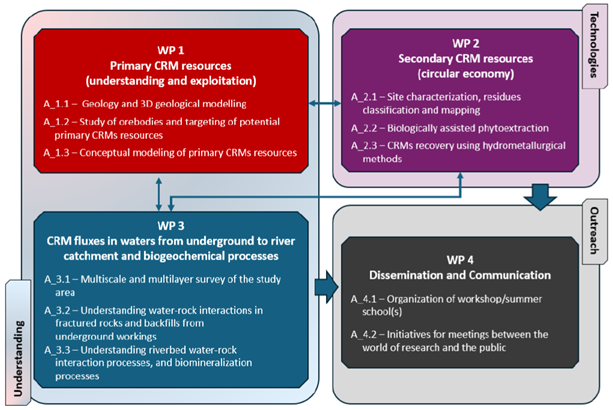
Work package structure
The project is structured in 4 work packages (WPs)
Main VIRTUS project’s outputs
- Scientific Publications and Conference Contributions: Virtus project’s main outcomes will be published in international peer-reviewed, open-access journals. The participation in international scientific conferences will enhance the dissemination of the main project’s outcomes and foster the development and strengthening of the scientific network(s).
- Validation of the multidisciplinary strategy for sustainable CRM assessment and valorisation at mining sites, addressing both primary and secondary resources.
- Characterisation, Mapping, and Classification Reports: detailed documentation of the mine site of interest, including data on the availability, quality, and accessibility of CRMs. These reports will encompass both primary exploitation and secondary resource recovery opportunities.
- Development of Environmentally-Sound Technologies: validation of innovative, advanced and low-cost technologies for extracting and recovering CRMs from mine tailings, with a focus on sustainability and minimal environmental impact.
- 3D Digital Hydrogeological Model: a digital model representing geochemical and hydrogeological processes from underground mines to surface water systems.
- Public Engagement Events and Workshop/Summer school: at least one major outreach event involving stakeholders and the general public to present the project’s objectives and outcomes. Organization of one high-level training event on CRMs in Sardinia, involving academia, industry, and public authorities.
Main VIRTUS’ impacts:
- Economic Growth and Sustainability: by tapping into the potential of mine sites for CRM extraction, the project will contribute to economic growth and the development of a sustainable raw materials sector, essential for technology, renewable energy, and electronics industries.
- Environmental protection and Circular Economy: the adoption of green and effective technologies will lead to the sustainable recovery of critical raw materials from mine wastes, thus fostering resilience on CRM supply and reducing the environmental risk related to mine activities, preserving biodiversity and human health.
- Reduced Dependency on Imports: The strategic utilization of domestic CRM resources will reduce Italy’s dependency on imported raw materials, enhancing national security and economic stability.
- Social and Community Benefits: Sustainable mining and CRM recovery will provide new opportunities for community development, preserving the quality of life for local populations.
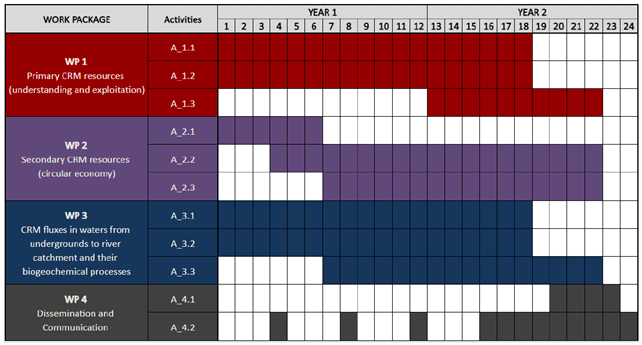
VIRTUS project’s Gantt
The VIRTUS project will last 24 months.