Project Abstract
The KORAL project aims to assess the impact of heavy metal contamination on Mediterranean coastal dune ecosystems through an innovative, multidisciplinary approach integrating classical ecological surveys with cutting-edge molecular analyses. Coastal dunes, critical yet threatened habitats, face pressures from urbanization, pollution, and climate change. Heavy metals, originating from anthropogenic sources, accumulate in soils, sediments, and organisms across terrestrial and marine food webs, posing severe ecological risks. KORAL will combine field surveys of vegetation, fauna, and marine macrobenthos with chemical analyses of pollutants. Molecular investigations will focus on two key bioindicator species and on microbial communities in soil and sediments, using genomics, transcriptomics, and metabarcoding. Comparative analyses between polluted and pristine sites, particularly in and near Italian Sites of National Interest (SIN), will reveal patterns of genomic erosion, differential gene expression, and shifts in microbial diversity linked to contamination. The project aims to identify novel biomarker genes for early detection of environmental stress, enabling improved monitoring, conservation, and restoration strategies. By integrating ecological, chemical, and molecular data, KORAL will provide a robust, ecosystem-wide framework for assessing and mitigating heavy metal impacts in coastal environments.
Team composition
The project team includes researchers from two CNR Institute (department DSSTTA) and Department of Ecological and Biological Sciences (DEB), Tuscia University:
CNR-IRET. The Research Institute of Terrestrial Ecosystems studies the structure, functioning and productivity of terrestrial ecosystems and the biotic and abiotic components with their interactions also in relation to global changes and anthropogenic pressure. The primary objectives are the study, protection, management and valorisation of natural resources and biodiversity. Particular attention is paid to the different levels of organisation, the function and the evolution of the terrestrial biome.
CNR-IRBIM. The Institute for Marine Biological Resources and Biotechnology of the National Research Council develops fundamental and applied research activities to study marine organisms, biodiversity and ecosystems and their evolution, in relation to global change and the anthropogenic impact.
Department of Ecological and Biological Sciences (DEB). The research activities carried out at the Department of Ecological and Biological Sciences are characterized by the study of the eco-evolutionary mechanisms that generate and support biodiversity and over the years have made essential contributions to the planning of strategies for the conservation and management of both terrestrial and marine biodiversity.
Key members involved and full team list:
The key members are:
- Principal Investigator (PI): Colangelo (CNR-IRET) has experience on the study of terrestrial ecosystems using different genomic techniques, both on plants and animals.
- Co-Principal Investigator (CoPI): Franchini (DEB, Tuscia University) has consolidated experience on different genomic approaches that complement the skills of the team components.
- Team Member: De Cinti and Sicuriello (CNR-IRET ) are expert of phytosociological surveys and analysis of indexes of stress of vegetation. Brunetti, Marzi and Antenozio (CNR-IRET) are experts of gene expression in plants and the study of the molecular mechanisms of tolerance and accumulation of heavy metals. Profeta and Giacobbe (CNR-IRBIM) are experts in the study of sublittoral coastal marine environment and macrozoobenthos community. Pioli (CNR-IRET) has consolidated experience in metabarcoding analysis of microbial communities in different context and a strong bionformatic background. Gramolini (CNR-IRET) is expert of genomics and transcriptomics in non-model organisms and bioinformatic analysis.
Work package structure
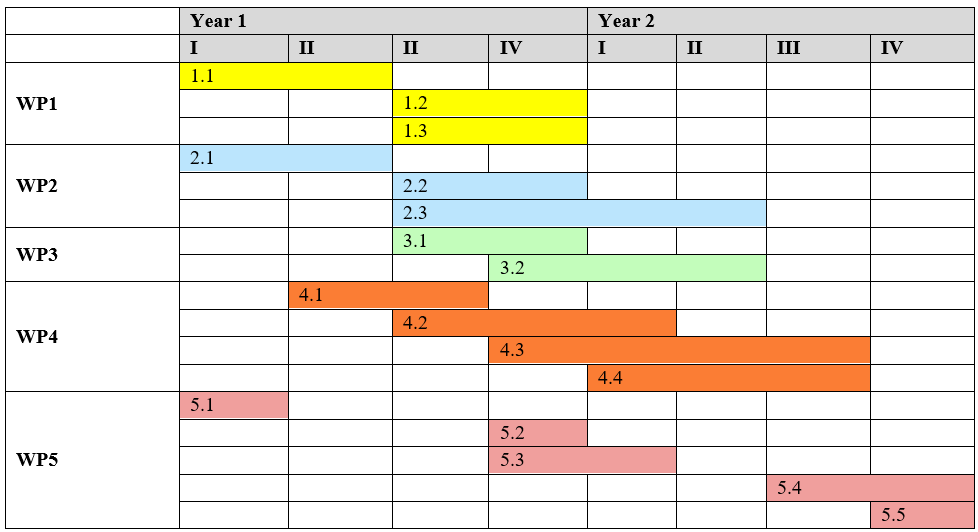
The project is structured into 5 Work Packages:
WP1 – Coastal dunes’ soil sample collection, community survey and contamination assessment
This WP is mainly devoted to field activities on coastal dunes and will do preparatory actions for other WPs, such as sample collection, characterization of pollutants, and stress assessment at community level.
- Task 1.1: Soil sampling for chemical analysis and microbiome characterization (WP2). Collection of plants and animal tissues for WP 3 and WP 4 sample collection; Phytosociological sampling; Sampling of arthropods communities
- Task 1.2: Chemical-physical analyses to characterize sites (soils, plants and animals) for the presence of common pollutants.
- Task 1.3: Statistical analysis of plant communities
WP2 – Marine Sample Collection, Macrobenthos community survey and granulometry
This WP is primarily dedicated to field activities, including sample collection, characterization of macrobenthos marine community, granulometry analysis and characterization of pollutants of sediment. These preparatory actions will support subsequent WPs.
- Task 2.1: Sampling marine sediments for chemical analysis and microbiome analysis (WP3) and sampling macrobenthos
- Task 2.2: Chemical-Physical Analyse
- Task 2.3: Statistical Analysis of Macrobenthos Communities
WP3 – 16S metabarcoding of marine and terrestrial microbiome
This WP focuses on the characterization of soil microbiome through metabarcoding of the 16S hypervariable region V3-V4.
- Task 3.1: Soil and sediment samples preparation, DNA extraction, 16S amplicon amplification. Sequencing of amplicons on Illumina MiSeq platform will be performed using external services.
- Task 3.2: bioinformatic analysis of raw metabarcoding data
WP4 – Population genomics and differential expression
The WP4 will focus on the assessment of genome- and transcriptome-wide diversity between polluted and pristine sites. The aim of the task is also to evaluate the role of standing genetic variation and differential expression on species resilience to heavy metal pollutants
- Task 4.1: chromosome-level de novo assembly of the Cakile maritima genome
- Task 4.2: Vergetation and fauna DNA/RNA extraction and library preparation
- Task 4.3: bioinformatic analysis of genome/transcriptomic-wide diversity.
- Task 4.4: identification of candidate biomarkers that will be tested using qPCR
WP5 – project management and dissemination
This is a management task devoted to ensuring project success, coordination and dissemination of the results
- 1 Kickoff meeting.
- 2 Intermediate meeting
- 3 Outreach activities and dissemination
- 4 Congress participation
- 5 Final report and dissemination
General Project Gantt Chart